

One of the first questions people ask about heat pumps is simple: how much electricity do they use? The answer depends on much more than the machine. Insulation, weather and especially the heat-emitter system all matter.
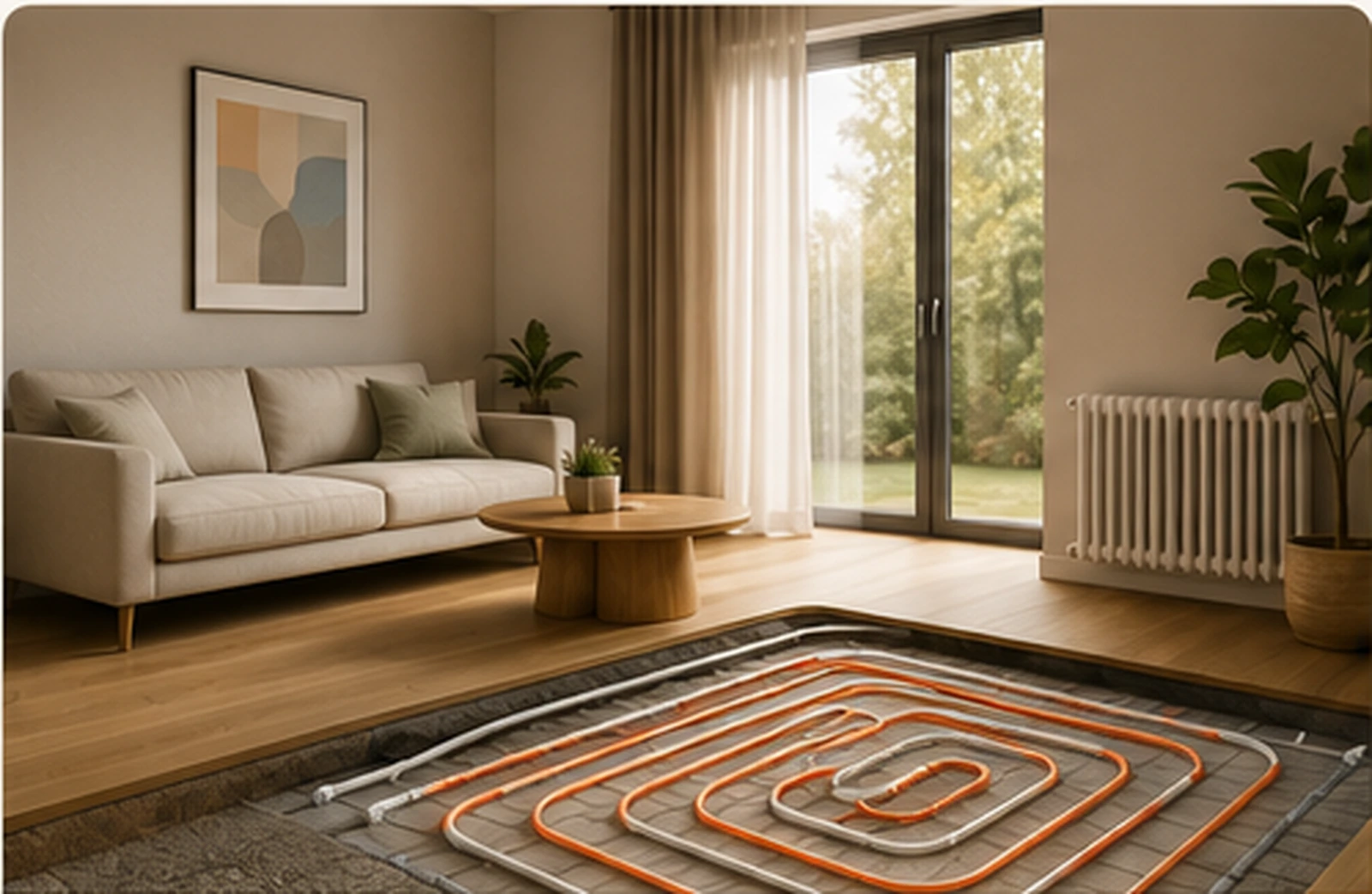
Heat emitters are the parts that actually warm the rooms: underfloor heating, radiators, fan convectors, wall heating or ceiling heating. With a heat pump, they are a major part of overall efficiency.
What does a heat pump actually do?
A heat pump moves heat instead of creating all of it directly from electricity. An air-to-water unit takes low-temperature heat from outdoor air and transfers it to the heating water. That is why one kWh of electricity can deliver several kWh of useful heat.
COP describes efficiency at one operating point. SCOP looks at a full heating season. In simple terms, a SCOP of 4 means roughly four units of heat are delivered for every unit of electricity used.
Why water temperature matters
The hotter the water has to be, the harder the compressor works. A system that heats the house with 30–35°C water will generally run more efficiently than one that needs 50–55°C.
Underfloor heating is a great match because an entire floor becomes a large warm surface. But it is not compulsory. Large radiators can work very well too.
A simple cost example
Assume a home needs 10,000 kWh of useful space heat per year. Using rounded illustrative prices of €0.30/kWh electricity and €0.09/kWh gas:
| Situation | Energy | Illustrative cost |
|---|---|---|
| Heat pump, SCOP 4.5 | ± 2,220 kWh | ± €667/year |
| Heat pump, SCOP 3.3 | ± 3,030 kWh | ± €909/year |
| Heat pump, SCOP 2.5 | ± 4,000 kWh | ± €1,200/year |
| Gas boiler, 90% seasonal efficiency | ± 11,110 kWh gas | ± €1,000/year |
Try the 50°C test
If you still have a boiler, choose a genuinely cold week and limit the heating flow temperature to 50°C. Keep the heating running steadily, avoid a large night setback and see whether every room remains comfortable for several days.
If it does, that is a strong positive signal. Try 45°C next. If only one room struggles, upgrading one radiator may be enough.
Radiators can work: a Weheat example
Weheat describes a real 1930s home with large traditional radiators that passed the 50°C test. A Blackbird was then installed. The Blackbird is an R290 monobloc with a published SCOP of 4.7.
What if underfloor heating is impractical?
Opening every floor during renovation can be expensive and disruptive. Space-heat therefore also offers wall heating and ceiling heating. Their large active surfaces allow low water temperatures as well.
Ceiling systems can also provide gentle cooling in summer. Mixed systems are possible too—for example underfloor heating downstairs and sufficiently large radiators upstairs.
The main lesson
Do not judge a heat pump only by its rated kilowatts. Insulation determines how much heat escapes, heat emitters determine how easily heat gets into the rooms, and controls determine how calmly and efficiently the whole system operates.
If a home stays comfortable with heating water at around 50°C on a cold day, a proper heat-pump assessment is definitely worthwhile.