

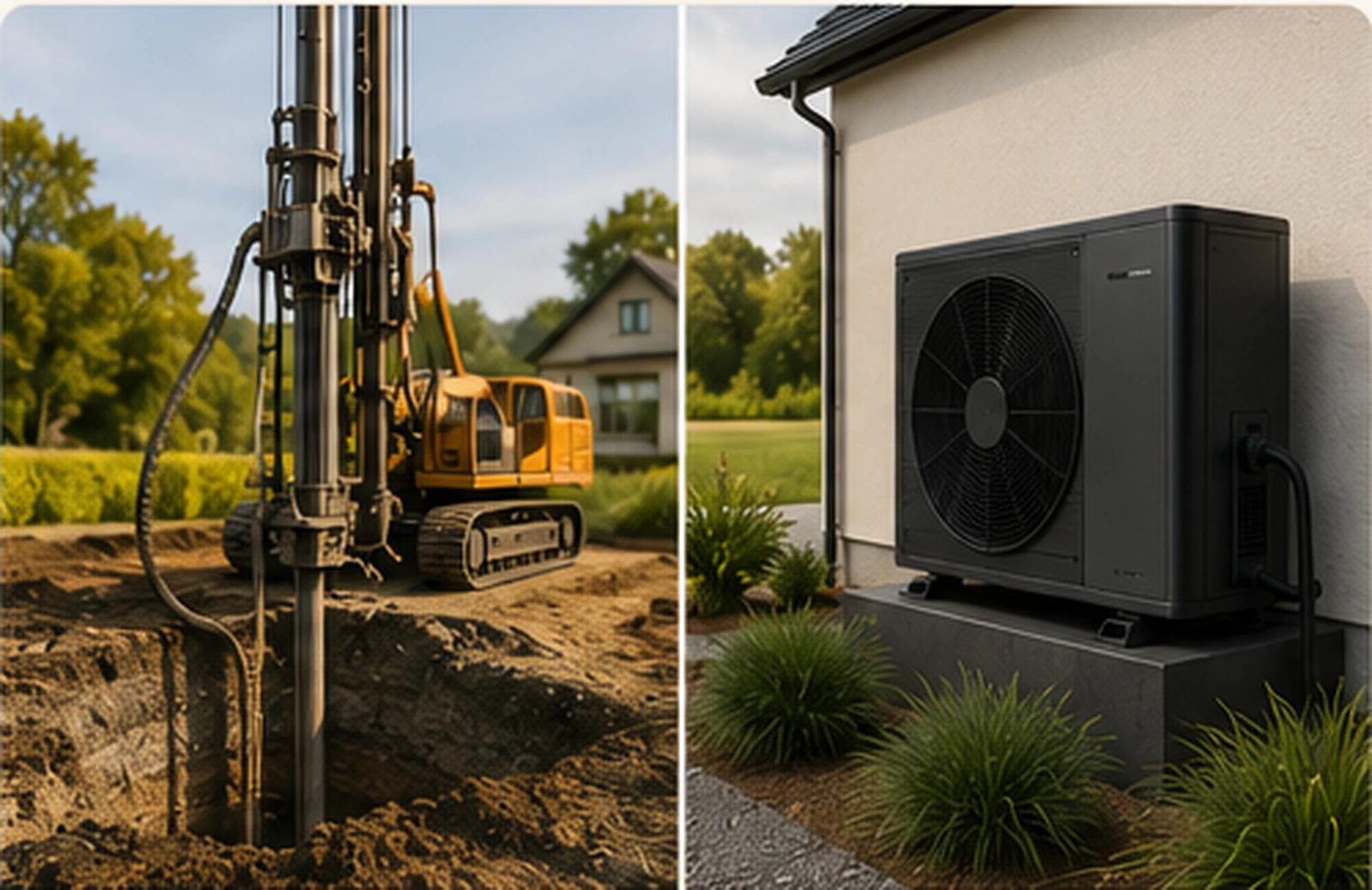
Ground-source heat pumps are often described as the best kind of heat pump. There is a good reason for that: the ground stays much more stable in temperature than outdoor air, so the heat pump has an easier source to work with in winter.
Two different heat sources
An air-to-water heat pump takes heat from outdoor air using a fan and compressor. A ground-source system uses vertical boreholes or a large horizontal collector buried in the ground.
Why ground-source is attractive
- a stable source even in cold weather;
- no visible fan unit outdoors;
- the possibility of very low-energy passive cooling.
Modern air-source systems have improved a lot
Recent air-to-water units can achieve seasonal efficiencies that come surprisingly close to modern ground-source systems. Ground-source still has an advantage in source temperature, but the gap is not always dramatic.
Belgium also has a moderate climate. Long periods when temperatures remain below freezing all day are uncommon, so an air-source unit spends only a small part of the year in its hardest operating conditions.
Highly insulated homes change the economics
Suppose a home needs only 5,000 kWh of space heat per year. At SCOP 4.7 that takes about 1,064 kWh of electricity. At SCOP 5.2 it takes about 962 kWh. The difference is around 102 kWh, or only about €31 at €0.30/kWh.
Domestic hot water also becomes a larger share of total heat demand in efficient homes. A modest space-heating efficiency advantage therefore does not automatically repay an expensive ground loop.
Boreholes add cost and complexity
Vertical ground loops need specialist drilling equipment, site access, groundworks and compliance with rules relating to soil and groundwater. Horizontal loops avoid deep drilling but require a large area of available land.
Passive cooling is a genuine advantage
A ground loop can often cool a building using very little compressor work. For buildings with substantial cooling demand, that benefit can change the decision.
Why we favour R290 monoblocs
With an R290 air-to-water monobloc, the full refrigerant circuit remains in the outdoor unit. Indoors, the installation is mainly water-based. It is simple, widely applicable and well aligned with the direction of European refrigerant legislation.
Conclusion
Ground-source is excellent technology, but it is not automatically the best investment for every house. For many Belgian homes, the extra drilling cost, site requirements and complexity are difficult to justify for a modest energy saving. That is why Space-heat mainly focuses on modern R290 monobloc air-to-water systems.