

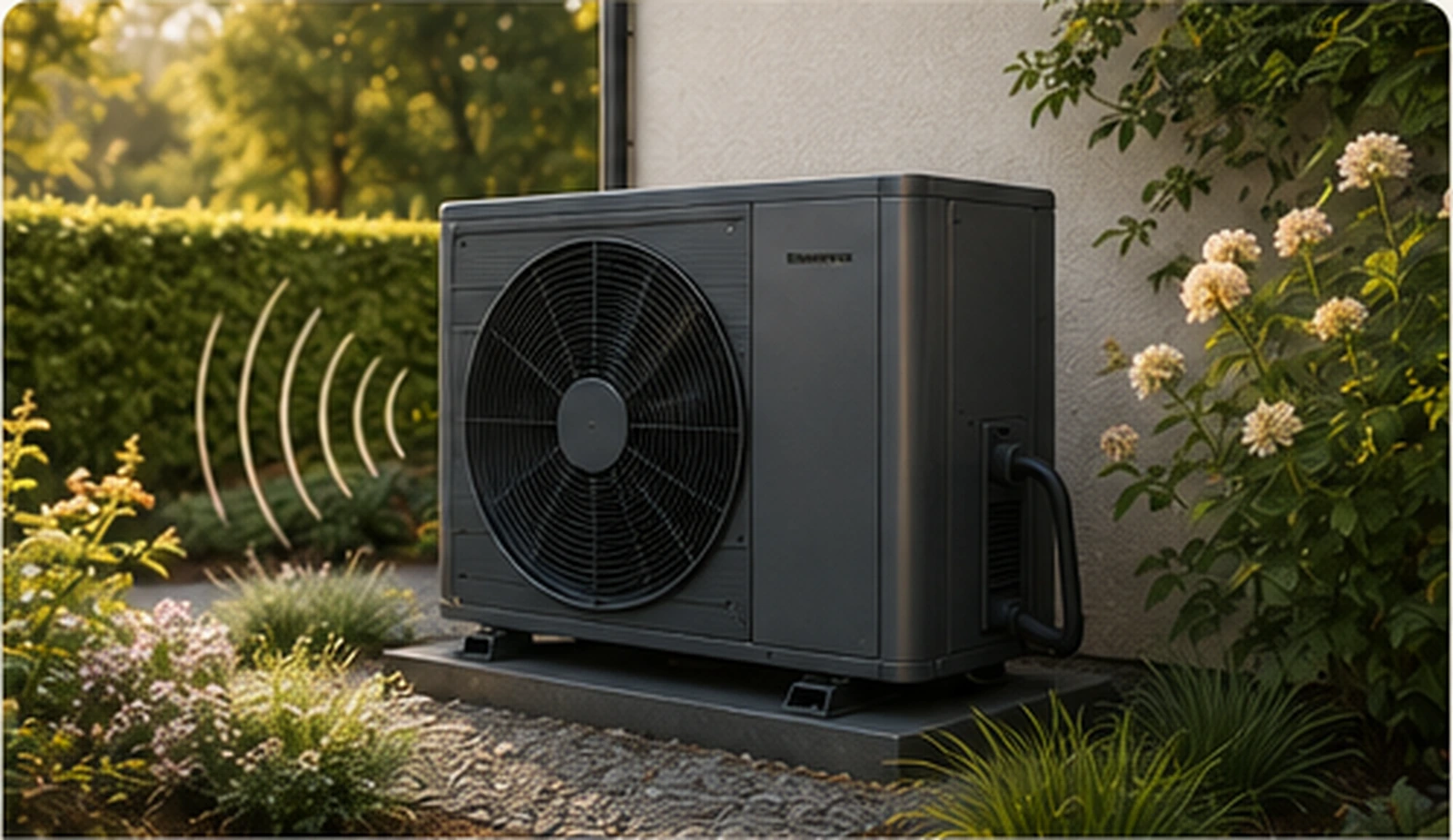
An air-to-water heat pump moves a large volume of outdoor air and uses a compressor. It therefore makes sound. The real question is how much sound reaches the place where someone can hear it.
Sound power versus sound pressure
Sound power describes the source itself. Sound pressure is what is measured at a particular location. It depends on distance, reflections, orientation, operating speed and vibration.
Siting matters
Sound generally falls with distance, but a unit squeezed between hard walls or placed in a corner can create extra reflections.
Vibration matters too
A compressor can transfer vibration into a lightweight structure. A rigid base and proper vibration isolation are therefore important.
Belgian guidance
Buildwise explains that environmental rules differ between the three Regions. Belgian standard NBN S 01-400-1 also limits sound radiation from installations towards neighbouring plots to 40 dB at the property boundary for the projects to which the standard’s criteria apply.
Weheat values
Weheat publishes 37.5 dB(A) for Flint, 40.5 dB(A) for Sparrow and 38 dB(A) for Blackbird in its comparison table. These figures help compare products, but real-world siting remains crucial.
Our approach
We consider bedrooms, neighbours, reflective corners, foundation stiffness, vibration isolation and night operation before installation. When in doubt, checking the acoustic situation beforehand is much better than fixing a nuisance afterwards.